A king hired a storyteller to fix his sons, and the stories went round the world
An old Indian scholar was given six months to make three dull princes wise. He used talking animals. His method travelled from Java to Iceland.
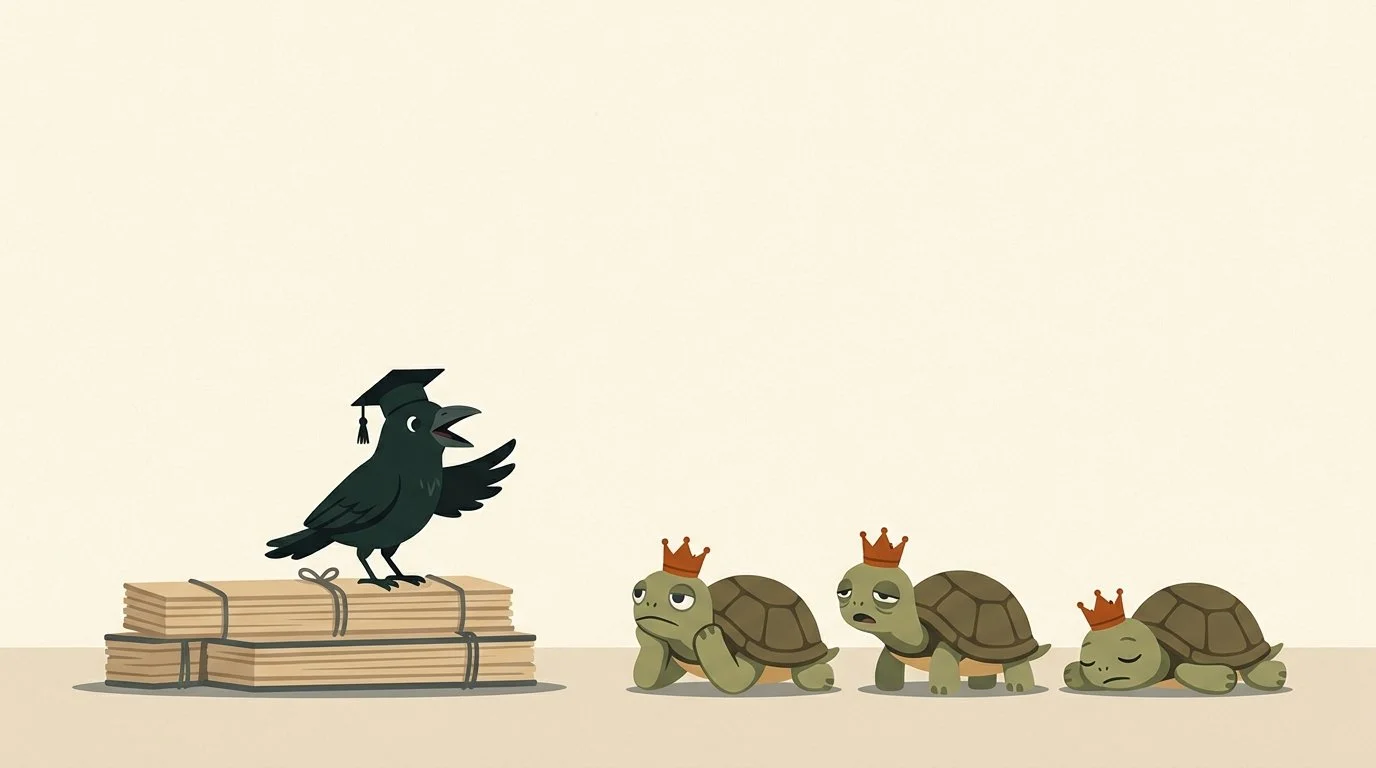
There is an old Indian story about a king with a problem. His name was Amarshakti, and he had three sons. Bahushakti, Ugrashakti and Anantshakti. All three were, to put it kindly, slow learners.
The king had tried the usual teachers, and his sons showed no interest in any of it. So his minister, Sumati, suggested a different man. An old scholar called Vishnu Sharma.
The king offered Vishnu Sharma a hundred land grants if he could teach the princes. The old man turned the reward down. He said he does not sell knowledge. Then he made a promise. Give me six months, and your sons will be wise.
He taught them with stories.
A lion and a bull who become friends, until a scheming jackal breaks them apart. A monkey who outwits a crocodile that wants his heart. A crow, a mouse, a tortoise and a deer who survive because they work together. Each story holds another story inside it, like a box inside a box. Each one ends with a lesson about friendship, enemies, money or power.
The collection became the Panchatantra, which means five treatises. Nobody knows exactly when it was written. What we do know is how far it went.
In 570 CE a Persian physician named Borzuya translated it into Middle Persian. Around 750 CE, Ibn al-Muqaffa turned it into Arabic as Kalilah wa Dimnah, and it became one of the most loved books in the Islamic world. From there it moved into Hebrew, Latin, Spanish, German, Italian and Greek. By 1600 it had been read, in one form or another, from Java to Iceland.
Think about that. A teaching tool built for three bored princes became one of the most travelled books in history.
Here is what I take from it as a marketer.
The princes were the hardest audience imaginable. Uninterested, distracted, and too important to be told off. Vishnu Sharma understood that a lesson given as a rule gets ignored, and a lesson given as a story gets remembered. Nobody forgets the monkey and the crocodile.
Most marketing still talks to customers like the old teachers talked to the princes. Features. Benefits. Twelve years of grammar.
The better approach is the Vishnu Sharma one. Find the small story that carries the point. A customer, a problem, a turn, an ending. Let the listener draw the lesson themselves.
The stories did one more thing that is worth copying. They were built to be retold. Short, vivid, with clear characters. A story that one person can tell another is a story that spreads without your budget.
Six months, three princes, a few talking animals. It is still the best marketing brief I have read.
Sources: Encyclopaedia Britannica, "Panchatantra"; Arthur W. Ryder, The Panchatantra (University of Chicago Press, 1925).