Budapest's telephone radio
In 1893 Budapest had a radio station, delivered by telephone
Decades before radio, a Hungarian inventor ran a daily news and music service over telephone wires to thousands of homes. Every streaming service today is a copy of it.
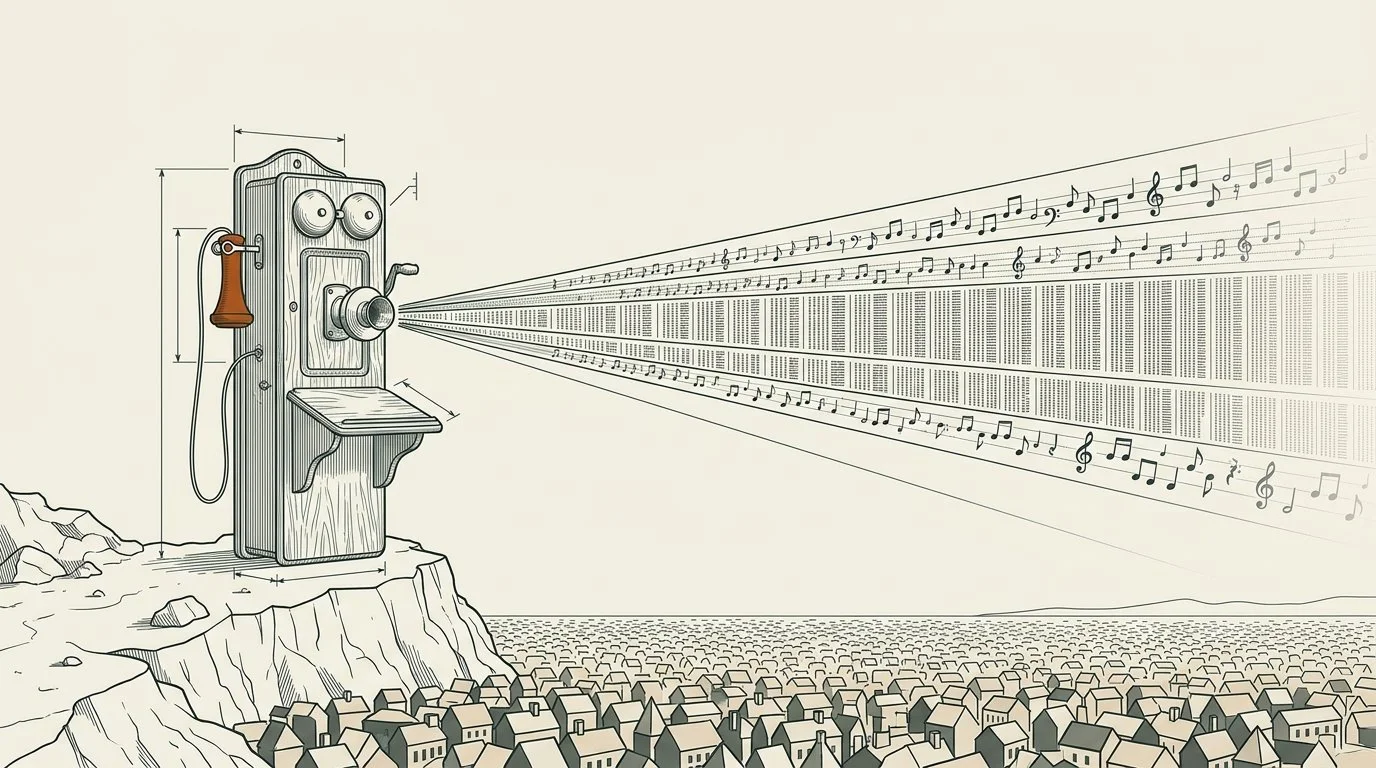
Here is a fact that changed how I think about new technology.
In 1893, in Budapest, you could pick up a telephone handset at a set time each day and hear a man reading the news. Stock prices in the morning. Parliament reports in the afternoon. Concerts and opera in the evening. It was called Telefon Hírmondó, which means roughly "telephone herald".
The man behind it was Tivadar Puskás, an engineer who had worked with Thomas Edison. He had already helped build telephone exchanges in Europe. Then he had a stranger idea. If one wire could carry one voice to one listener, why could a system of wires not carry one voice to thousands?
So he built it. Subscribers had a special receiver on the wall. A printed schedule told them what was on each hour. Readers sat in a studio and spoke into the line. For a small monthly fee, a family in Budapest had, in effect, a radio station, more than twenty years before radio broadcasting existed.
It ran for decades. When real radio arrived in Hungary in the 1920s the two services were merged.
The part I keep coming back to is this. The telephone was invented as a tool for two people to talk. Everyone understood it that way. Puskás looked at the same wires and saw a newspaper, a concert hall and a stock ticker.
Nothing new was invented. The technology was already in the walls. The innovation was a different question: what else could this thing be?
This happens every single time. The internet was built for universities to share files. Text messages were an afterthought in the mobile phone standard, added for engineers to test networks. The camera on a phone was a gimmick until someone built a place to share the photos.
So when a new tool arrives, I now ask two questions. What was it made for? And what else does it do that nobody is using yet?
Most of the AI tools on my desk were built to answer questions. I use them to write scripts, run spreadsheets, and plan podcasts. The next wave of businesses will be built by people asking Puskás's question about these tools.
A man in Budapest, in 1893, invented streaming audio with wire and patience. It is worth remembering when someone tells you a new technology only does one thing.