The box that changed trade
A trucker who hated waiting at the docks changed the price of everything
The shipping container is a plain steel box. Its inventor was an impatient truck driver. The box is the reason a T-shirt from Bangladesh costs what it does.
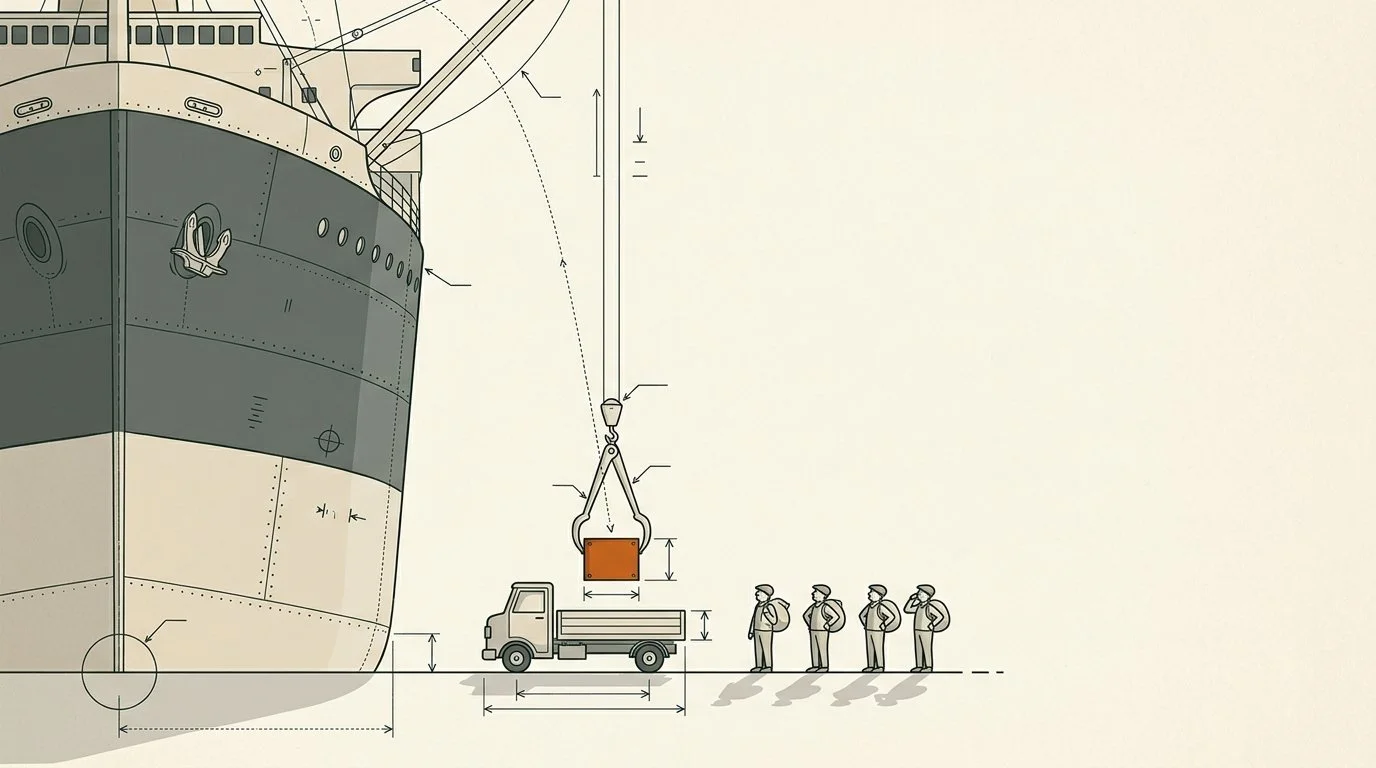
In the 1930s a young truck driver named Malcom McLean sat at a dock in New Jersey, waiting. His truck was full of cotton bales. Men were carrying them off, one at a time, onto a ship. It took all day. He sat there, losing money, and had a thought that would take him twenty years to act on.
Why unload the truck at all? Why not lift the whole body of the truck onto the ship?
That was the idea. The whole idea. A steel box, standard size, that could go from truck to ship to train while the goods inside stayed sealed.
On 26 April 1956 a converted tanker called the Ideal-X sailed from Newark to Houston with 58 of those boxes on deck. Loading that ship by hand would have cost many times more per tonne than lifting the boxes on with a crane.
Before the box, the cost of shipping decided what was worth shipping. Most goods were made close to where they were sold, because moving them was slow, expensive and risky. Things got stolen on the docks. Things got broken. A ship spent more time in port being loaded than at sea.
After the box, distance stopped mattering much. A factory could be anywhere. A shirt could be cut in one country, sewn in another, sold in a third. The whole modern supply chain, the one I spent years of my career inside, runs on McLean's box.
What strikes me is how little was invented. Steel boxes existed. Cranes existed. Ships existed. McLean's contribution was a standard and a refusal to accept that the slow way was the normal way.
The hard part was never the box. It was getting the ports, the unions, the railways and the shipping lines to agree on one size. That took years of arguments and a lot of money lost. The idea was obvious. The agreement was the innovation.
I see a version of this in most businesses. The tool is rarely the bottleneck. The bottleneck is a process everyone accepts as normal. Someone sitting in the equivalent of McLean's truck, thinking "why do we do it like this".
He went on to become one of the richest men in the shipping industry, lost most of it, and made it again. All from one afternoon of being annoyed at a dock.
Next time you are stuck waiting on a process that makes no sense, write down the question. It might be worth more than the business you are in.